

BPA-Free vs Phenol-Free Thermal Paper: What the Labels Actually Mean
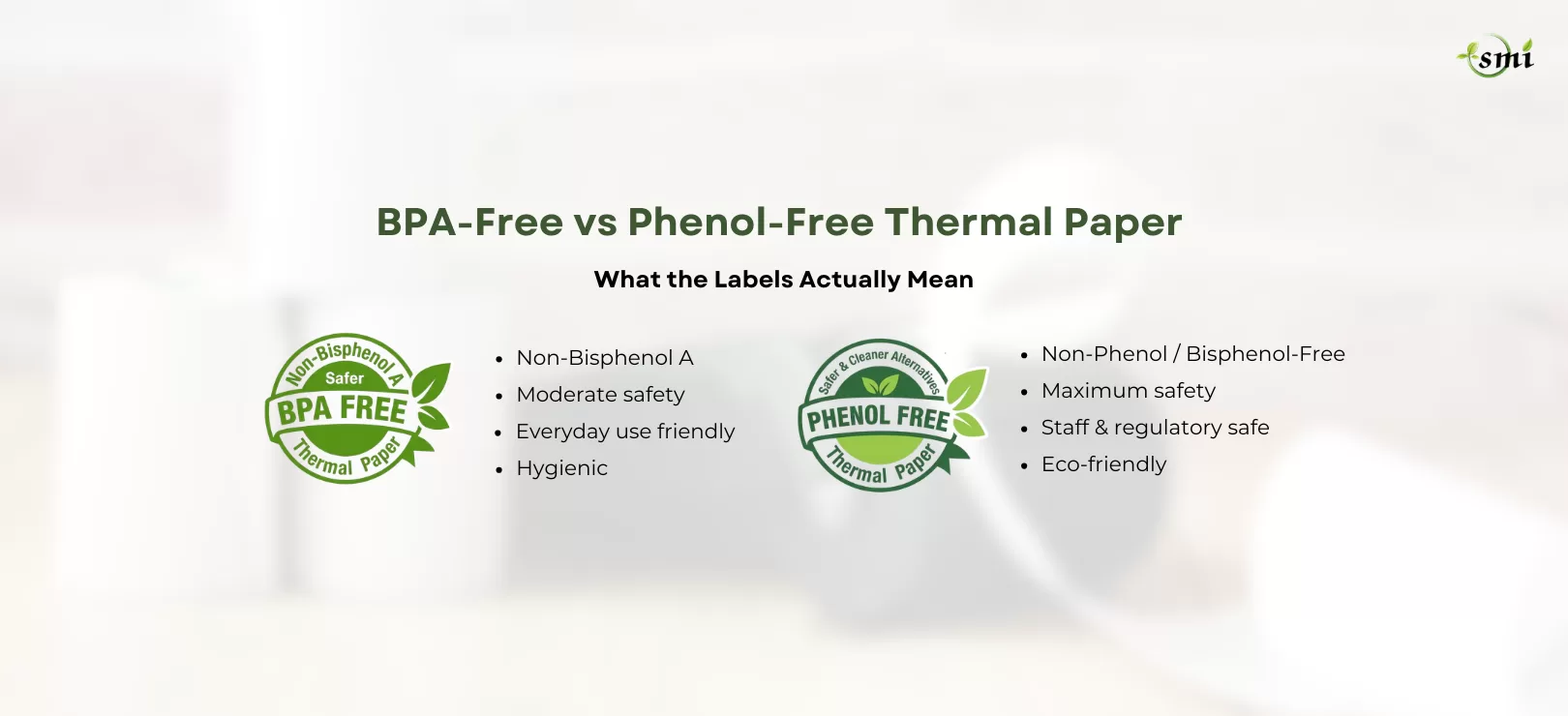
Walk into any major retailer today, and there is a good chance your receipt is labelled BPA-free. It sounds reassuring. For businesses that handle receipts daily, understanding what these labels actually mean is critical.
Whether you are sourcing thermal paper rolls for a POS system, ATM, petrol station, or self-service kiosk, knowing the difference affects staff safety, compliance, and export readiness.
This guide explains BPA, phenol-free labels, their differences, and what questions to ask your supplier to ensure safety and compliance.
Quick Answer: BPA-Free vs Phenol-Free Thermal Paper
- BPA-free thermal paper contains no BPA but often uses BPS or similar chemicals.
- Phenol-free thermal paper contains no bisphenols at all.
- Phenol-free is the safest and most future-proof option for businesses handling receipts daily.
How Thermal Paper Works: The Role of the Chemical Developer
Before discussing BPA and phenol labels, it is important to understand why these chemicals are used in thermal paper.
Thermal paper does not use ink. Instead, it is coated with a heat-sensitive layer that contains three main components:
- Leuco dye: a colourless compound that darkens when activated by heat.
- Colour developer: an organic acid that reacts with the leuco dye when heat is applied, producing the printed text or image.
- Sensitiser: a chemical that lowers the activation temperature and improves print sharpness.
The colour developer is the chemical that drives the BPA and phenol discussion. Historically, Bisphenol A (BPA) was widely used because it is cheap, effective, and stable.
What Is BPA and Why Was It Phased Out?
Bisphenol A (BPA) is a synthetic chemical in the phenol family. It has been used for over 60 years in products such as polycarbonate plastics, epoxy resin linings for food cans, and thermal paper coatings.
The main concern with BPA is that it is an endocrine-disrupting chemical. Research shows BPA can mimic estrogen, potentially affecting fertility, fetal development, immune function, and metabolism. For most people, brief contact with receipts poses minimal risk. The real concern is for employees who handle receipts daily, such as cashiers, bank staff, and retail workers. Studies indicate that just five seconds of contact with BPA thermal paper can transfer 0.2 to 6 micrograms of BPA to dry skin. Moist or treated skin can increase this transfer by up to ten times.
This evidence has led to regulatory action. In January 2020, the European Union banned BPA in thermal paper under Regulation (EU) 2016/2235, which amended Annex XVII of the REACH Regulation. Any thermal paper containing 0.02% BPA by weight (200 mg/kg) or more is prohibited. The UK implemented similar rules, while Switzerland went further, banning both BPA and its common replacement, BPS, the same year.
In the United States, federal BPA restrictions for thermal paper do not yet exist. However, state-level regulations are increasing. Connecticut, Illinois, and Washington State have banned or restricted BPA in receipt paper, and California’s Proposition 65 requires disclosure of BPA exposure risks. Several other states are introducing similar legislation.
What Does “BPA-Free” Really Mean?
When a thermal paper roll is labelled BPA-free, it means the paper’s heat-sensitive coating does not use Bisphenol A as its colour developer.
This sounds reassuring, but it does not always solve the safety concern.
After the EU restriction on BPA in 2020, manufacturers needed a replacement developer that was chemically similar. The most common substitute became Bisphenol S (BPS). BPS has a similar molecular structure to BPA, belongs to the same phenol chemical family, and performs almost identically in thermal printing. Research suggests it may carry similar endocrine-disrupting risks.
A 2022 study of 571 thermal paper receipts in the United States found that BPS was present in about 85% of tested receipts. In the EU, surveys after the 2020 BPA ban showed BPS quickly became the dominant alternative in the reformulated market.
The takeaway: a receipt labelled BPA-free may still contain BPS.
The label is accurate—it contains no BPA—but it has simply replaced one bisphenol with another.
Switzerland acted early and banned both BPA and BPS in thermal paper in 2020. The EU is now considering restrictions on the broader bisphenol chemical family.
BPA-free does not mean chemical-free. Always ask suppliers what developer is used.
What Does "Phenol-Free" Mean?
Phenol-free thermal paper is the most comprehensive option. It contains no BPA, no BPS, and no other phenol-family compounds from the bisphenol chemical group.
Instead, it uses alternative developers that are structurally unrelated to phenols. Common options include:
- Pergafast 201 (PF201): A urea-based sulfonyl compound developed by Solenis (formerly BASF). It was the first non-phenolic colour developer produced at commercial scale and is now the leading alternative in regulated markets. Studies show that skin absorption of PF201 is much lower than BPA, and in vitro tests found no significant endocrine activity at levels relevant to receipt handling. In Switzerland, where the BPS ban pushed for alternatives, PF201 became the dominant developer, making up roughly 60% of the market by 2021.
- Vitamin C-based developers: These use ascorbic acid derivatives as the primary colour developer. They are non-phenolic, considered low-risk, but tend to be more expensive and less thermally stable in certain conditions.
- Blue4est® technology: Developed by Koehler Paper, this approach avoids chemical developers entirely. Instead, micro air pockets in a blue top layer collapse under heat, revealing a black layer beneath. The printing process is fully physical, the paper is fully recyclable, and it is approved for food contact applications.
The key difference: phenol-free uses a completely different chemical class, not just a replacement.
This makes it the safest and most future-proof choice for businesses handling receipts daily or selling into regulated markets.
The Label Hierarchy: Understanding What You Are Actually Buying
| Label | What it means | What it may still contain |
|---|---|---|
| Standard thermal paper | May contain BPA | BPA |
| BPA-free | No BPA | Likely BPS or other bisphenol |
| BPA & BPS free | No BPA/BPS | May contain other bisphenol variants (BPF, D-8, etc.) |
| Phenol-free | No BPA, BPS, or phenols | Alternative developers only (Pergafast 201, ascorbic acid, etc.) |
The higher you go up this hierarchy, the broader the chemical exclusion.
Phenol-free is the most comprehensive and future-proof option.
Why This Matters for Your Business
1. Staff Handling Receipts
- Daily exposure adds up for cashiers, retail staff, and delivery drivers.
- Phenol-free paper reduces chemical risks without compromising print quality.
2. Regulatory Compliance
- EU/UK: BPA-free is minimum; phenol-free gives extra assurance.
- US: State-level BPA regulations; phenol-free protects against evolving legislation.
3. Sustainability & Recycling
- BPA and BPS can contaminate paper recycling streams.
- Phenol-free thermal paper is easier to recycle and more eco-friendly.
4. Customer & Brand Perception
- Consumers increasingly notice sustainability and safety claims.
- Using phenol-free paper supports ESG initiatives and brand trust.
Does Phenol-Free Affect Print Quality or Printer Compatibility?
This is a common question, and the short answer is: for most applications, no.
Most phenol-free thermal papers, especially those using Pergafast 201, perform just like standard BPA or BPS papers. They produce sharp prints, work with the same printers, and usually do not require any printer adjustments.
Some differences may appear in certain conditions:
- Print longevity: Receipts may fade slightly faster if stored in very high heat, direct sunlight, or in contact with oils or plastics. For typical retail use, this is rarely a problem. For archival needs, check with your supplier.
- Cost: Phenol-free papers usually cost a little more than BPS-based papers. The difference depends on the grade and order size, but it is generally manageable for bulk purchases.
For businesses in food service, healthcare, or high-contact environments, the small cost increase is often worth it for the added safety and reduced liability.
SMI Paper Industry's Approach
At SMI Paper Industry, we supply thermal paper rolls to meet diverse regulatory and operational needs:
- BPA-free thermal paper
- BPA and BPS-free thermal paper
- Phenol-free thermal paper
All products are produced in our ISO 9001:2015-certified facility in Penang, Malaysia. We are a Sedex member and conduct regular SMETA audits to ensure our manufacturing processes uphold high ethical and responsible business standards, covering areas such as labor practices, health and safety, and environmental management.
Explore our range of thermal paper rolls or contact us to find the best fit for your business today.
Frequently Asked Questions (FAQs)
What is the difference between BPA-free and phenol-free thermal paper?
BPA-free paper does not contain Bisphenol A, but it may still contain BPS or other bisphenol derivatives. Phenol-free paper excludes all phenol-family developers and uses alternative, safer chemistry.
Can phenol-free thermal paper be used in standard POS printers?
Yes. Modern phenol-free papers are designed to perform like BPA or BPS papers. They produce sharp prints and are compatible with most POS, ATM, and kiosk printers.
Does BPA-free mean thermal paper is completely safe?
Not always. BPA-free only guarantees no Bisphenol A. Many BPA-free papers use BPS, which may have similar endocrine-disrupting properties. Phenol-free paper provides the most comprehensive chemical safety.
How can I verify the chemical developer used in my thermal paper?
Ask your supplier for the exact developer name (for example, Pergafast 201 or ascorbic acid-based). Request the Material Safety Data Sheet (MSDS/SDS) for chemical confirmation.
Is phenol-free thermal paper more expensive?
Phenol-free papers can carry a modest price premium compared to BPS-based papers. However, the increased safety and regulatory compliance often justify the cost, especially for businesses with high-volume receipt handling.
Why does regulatory compliance matter for thermal paper?
EU, UK, and some US states have restrictions on BPA in thermal paper. Using BPA-free or phenol-free products ensures your business meets legal standards and protects staff and customers.
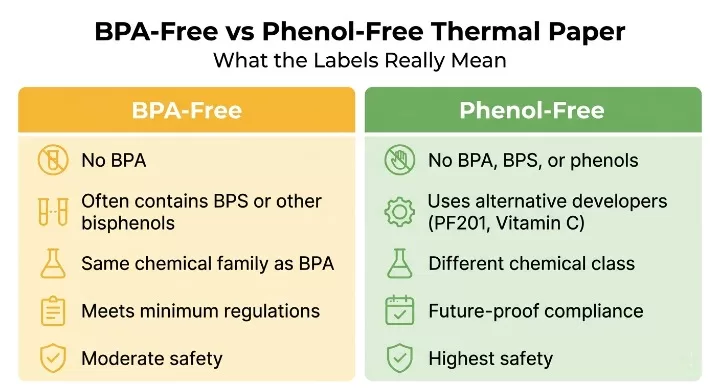
Quick Reference Summary
- Standard thermal paper may contain BPA. Avoid for EU/UK markets.
- BPA-free contains no BPA, often contains BPS. Meets EU/UK legal minimum.
- BPA & BPS free is better than BPA-free, may still contain minor bisphenol variants.
- Phenol-free contains no phenol-family chemicals. Safest and most future-proof choice.
Always confirm the developer and review the SDS. Labels alone may not tell the full story.
Disclaimer
The information in this article is for general informational purposes only. For advice tailored to your business or printing needs, please consult a qualified professional or contact our team. While we aim for accuracy, we cannot guarantee the content is error-free, and SMI Paper Industry is not responsible for any errors or omissions.